Our products
GENIE — our flagship product.
GSLTech builds systems for institutions across several sectors. Our first, and our flagship, applies the company thesis to tertiary education. GENIE is the system of record for an institution’s academic life — enrolment, teaching, presence, supervision, assessment, clearance, progression and governance, held as one connected record.
The tripartite mandate
Teaching, research and community service
Every university carries all three. GENIE evidences all three.

Teaching
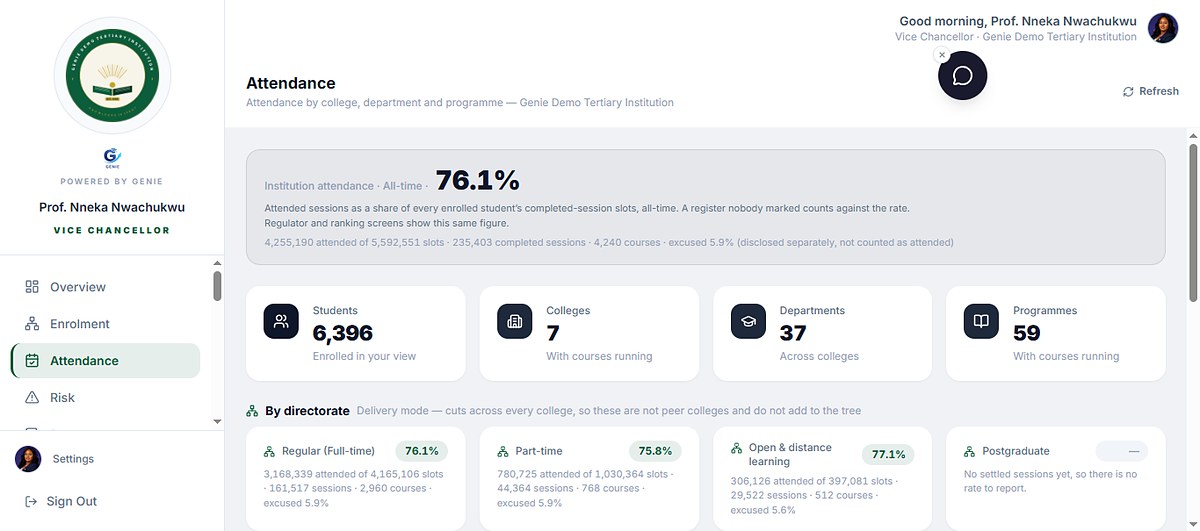
Whether a class was actually held, not merely timetabled. Presence captured against a mapped venue boundary, on a device bound to that student, with an on-device biometric assertion, and re-validated when the network returns. Syllabus coverage tracked week by week, per programme and per faculty.
Research
That research project supervision took place — undergraduate and postgraduate alike. Meetings, milestones and written observations recorded as tamper-evident, append-only evidence, together with whether the student acted on them.
Community service
The least-evidenced mandate of the three. Outreach, extension and public engagement recorded as scheduled, attended, verified activity rather than a claim made in a promotion file.
The method
Triangulation, not self-report
How one class session becomes evidence
The lecturer
Files a diary of the session — what was taught, and how far the syllabus advanced.
The class representative
Files a separate diary, elected by the cohort and recorded independently.
A rotating student sample
Confirms anonymously. The record carries no link back to who answered.
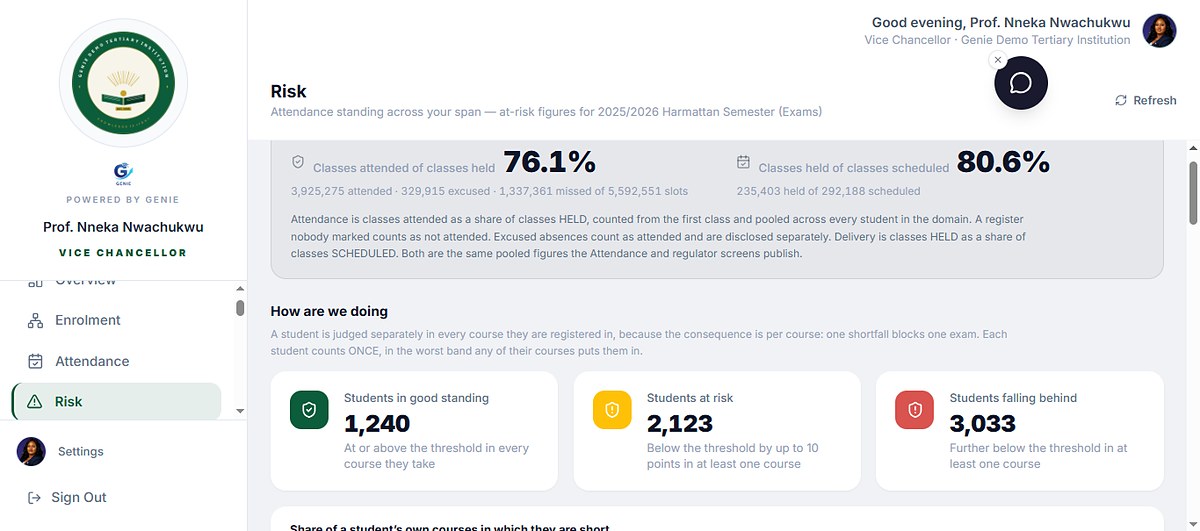
Every surface in the system computes attendance the same way. There is one rule, not six.
Who it serves
Six kinds of user, each with a role-derived view
Students
Their attendance, their standing against the eligibility threshold, their results — on the phone they already carry.
Lecturers and trainers
Attendance in seconds instead of registers and chasing. The diary is their account of the session, not a judgement of them.
Parents, sponsors and guardians
Told the same day when a ward misses a class, with a weekly summary. Their own wards, and nobody else's.
Administrators
From departmental heads to principal officers — one record, one owner per fact, an audit trail.
Proprietors and councils
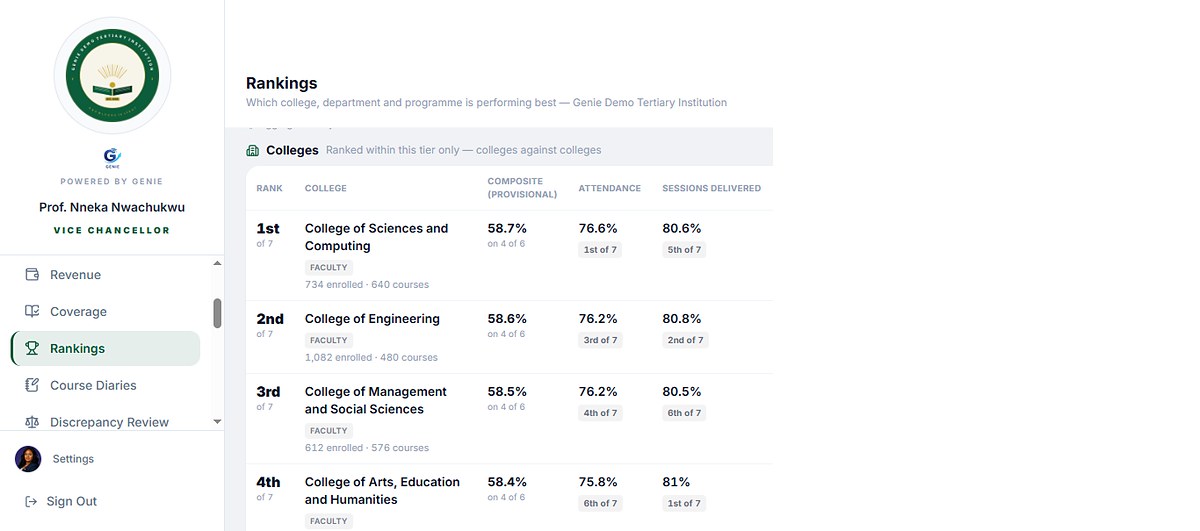
How the institution is performing, at the level of aggregate where a founder governs.
Regulators
A directory, rankings and sector comparison drawn from source data — each regulator fenced to its own statutory remit.

Access
Three channels of equal standing
Web, native mobile applications for Android and iOS, and WhatsApp via the Business API — with offline capability throughout. This is a deliberate response to Nigerian connectivity and device reality: a student on a low data bundle has the same functional access as one on unlimited bandwidth.

What has actually been built
The system, described plainly
Software companies are easy to announce and hard to verify. This is what exists and runs today, stated so that a technical reader can judge it.
The backend
A Django REST API over PostgreSQL, organised into eight bounded domains — identity and access, academic structure, attendance and presence, examinations and eligibility, research supervision, analytics, billing, and messaging. Roughly 194,000 lines of Python, with a further 155,000 lines of tests. Multi-tenant throughout: every institution’s data is fenced from every other’s in software, not by convention.
The clients
A React single-page application for administrators and staff; React Native applications for Android and iOS sharing one codebase; and a WhatsApp channel built on the Business API as a first-class interface rather than a notification pipe. All three read the same API and enforce the same rules.
Presence capture
Check-in against a mapped venue boundary, on a device bound to that student, with an on-device biometric assertion and a time-expiring session code. Captures made without a network are queued and re-validated on reconnection rather than trusted. Anomalies are flagged and corroborated, never silently accepted.
Applied AI
A multi-provider layer with semantic caching, so a repeated question is answered from a previous result rather than a fresh call, and a metered token ledger that accounts for every unit consumed. Used for document compliance analysis, semantic retrieval and bounded conversational assistance — never for scoring a student.
Billing
Institutional subscription and student wallet handling through Flutterwave, with billing separated from the academic record: what a student owes never determines what the attendance system records about them.
Infrastructure
Containerised on Google Cloud Run with managed Cloud SQL, secrets held in Secret Manager, scheduled work on Cloud Scheduler, transactional email over Amazon SES with automated bounce and complaint suppression, and health probes with error monitoring in front of it all.
None of this is unusual engineering. What is unusual is being willing to say precisely what exists, and to be checked on it.
How we know it works
The evidence, not the assurance
8,506 automated tests
Run against a live PostgreSQL instance on every change — roughly 155,000 lines of test code against 194,000 lines of application code, under a 70% coverage floor enforced in continuous integration. There is a test file for very nearly every application file in the backend: 442 against 441. A change that breaks a rule cannot be deployed, because the deployment waits on the suite.
Adversarial fence testing
Privacy boundaries are attacked rather than assumed. The boundary preventing an institution’s proprietor from reaching any individual student’s record was verified against twenty-one distinct attempts to invert, reorder, page past and widen it. All twenty-one failed.
Continuous security surveillance
Static analysis with CodeQL and bandit, dependency vulnerability auditing across all three ecosystems with Dependabot, pip-audit and npm audit, and a retained, dated scan history — the artefact an assessor asks to see.
Append-only where it matters
Research milestones and supervision attestations cannot be edited once recorded. A verifier who changes position files a second statement; the first remains. History is not rewritten, it accumulates.
One rule, computed once
Every surface that reports attendance computes it the same way, and a test asserts that every entry point agrees on the same student. There is no version of the number that is convenient to a particular office.
Automated honesty checks
A guard suite asserts that no surface substitutes a plausible figure for a missing one. Absent data renders as absent, and a change that reintroduces a fabricated default fails the build.
Beyond education
The same thesis, other institutions
GENIE is the first application of a general idea, not the whole of it. The problem it solves — a record that is the institution’s own account of itself, reaching the accountable person too late to act — is not peculiar to universities.
Health
Whether a clinic was staffed, whether a consignment arrived, whether a procedure followed its protocol — the same triangulation problem, with higher stakes.
Public service
Attendance, delivery and clearance across dispersed offices, where the reporting line is long and the verification is nil.
Security and defence logistics
Within our registered objects, and the reason our architecture was designed to fail closed rather than fail open.
These are directions the company is constituted for and is building toward. They are not present capability, and we do not describe them as such.